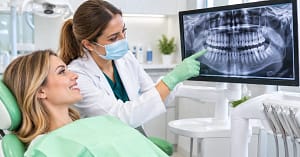
Have you ever questioned your dentist as to why he would need to take an X-ray even though your teeth appear healthy?
Well, I bet many people share your doubt about this, because this is a very frequent question in our clinic. There is one very clear answer to this question.
Namely, a visual inspection can tell a dentist about the condition of your teeth, but only on the surface level.
The naked eye cannot see the processes that occur inside the tooth, between them, under the gum line, and in the jawbone itself. That is why digital X-rays can reveal the invisible to us.
| Quick Answer
Digital X-rays are used by dentists to examine for tooth decay between the teeth, examine bone level, find any infection or abscess in the mouth before causing pain, determine where developing teeth are positioned, and provide guidance during treatments such as root canals and implants, which cannot be determined visually. The modern digital dental X-ray exposes patients to as little as 80%–90% less radiation than traditional film X-rays. |
Digital X-Rays vs Traditional Film X-Rays – What Changed?
Dental radiographs involved the use of films that had to be developed through a chemical process that took a lot of time, in addition to needing a dark room, as well as involving high doses of radiation to produce an image.
This was replaced by digital radiography, which made use of an electronic sensor that instantly showed the image on the screen.
The advantages to the patient include:
| Factor | Traditional Film X-Rays | Digital X-Rays |
| Radiation dose | More – needed higher exposure to process the film | Up to 80–90% cheaper than film |
| Image availability | Minutes to process in a dark room | Seconds – shown on screen during consultation |
| Image quality | Permanent — after processing | Images can be magnified and enhanced on the screen |
| Chemical processing | Needs — hazardous to the environment | None |
| Patient experience | Slow, needs more waiting | Quick, images viewed immediately |
This means that the whole procedure becomes quicker, provides more accurate images, and even allows you to see from the screen what the dentist sees in your mouth rather than showing you a picture from the film under the light.
What Can Digital X-Rays Actually Detect?
This is where the clinical significance of X-ray imaging becomes very apparent. Below is what X-rays show us that visual inspection cannot:
Decay Between Teeth (Interproximal Cavities)
Decay occurs most frequently in places between teeth.
Also, these are places where a toothbrush is less effective in cleaning. No matter how well you clean your mouth, bacteria can form cavities in these spots that will be completely invisible from the outside.
The bitewing X-rays, those that are taken from the side, are used in order to detect such cavities before they become big enough to require something more than just a filling.
Bone Loss and Gum Disease Progression
Gum disease, or periodontal disease, damages the bone supporting the teeth, but bone damage does not cause pain in its early and moderate stages.
X-ray images help to determine the amount of remaining bone support of each tooth, helping to make decisions about the treatment needed. It is especially true for patients who have not been seen by a dentist for several years.
Infections and Dental Abscesses
An abscess of the tooth or gums, which is an infection around the root of the tooth or in the tissue around it, can be seen through the X-ray as a dark area before it causes any pain.
Detecting and dealing with an abscess in its initial stages is important to ensure that it does not spread into a larger problem requiring complicated treatment.
Impacted Wisdom Teeth
It is not easy for a person to determine whether the wisdom teeth are impacted or not, or whether they affect the other neighboring teeth in any way, but this information is clearly visible through an OPG X-ray.
OPG X-rays are mostly recommended to teenagers and young adults in Pakenham.
Root Canals, Implants, and Treatment Planning
Whenever your dentist plans a root canal procedure, dental implants, or even a crown, he/she needs to know how the tooth and bone look inside.
X-ray images are not optional in these cases – they serve as a road map for your dentist.
How Safe Are Dental X-Rays?
This is the first question most patients have, and the good news is that digital dental X-rays expose you to a very low level of radiation.
To give an idea of what a low radiation dose is: a normal set of bitewing X-rays expose you to the same amount of radiation as being on a short plane trip.
Australian dental practices adhere to the ALARA philosophy – As Low As Reasonably Achievable – meaning that only if there is a medical need for a patient to get their teeth X-rayed will they get one.
And if they do, then the minimum dose of radiation possible is delivered.
Are Dental X-Rays Safe for Children?
Yes, but only with proper precautions. Since the teeth of children are still developing and changing, there is great benefit in taking an X-ray to monitor the changes.
The lower amount of radiation involved in digital X-rays makes it an ideal choice for children. Your dentist at Pakenham Shine Dental will determine if you need an X-ray depending on your child’s age.
What About During Pregnancy?
Generally, elective dental X-rays are not done in the first trimester as a safety precaution.
In the event that there is an urgent need for either a diagnosis or the treatment of any dental condition, it is possible to have the X-rays done after applying the necessary shields.
The radiation exposure of one digital dental X-ray is deemed to be minimal.
How Often Do You Actually Need Dental X-Rays?
The frequency of X-rays is a matter of personal decision by your dentist, considering your specific case.
- Patients with no previous dental issues and minimal decay risk: bitewing X-rays every 12-24 months for routine dental examination
- Patients who suffer from decay, gingivitis, or complicated medical history: more frequent, depending on the need to observe the progress in treatment
- First-time visit at the dental clinic: full set of X-rays to create a background and form a treatment strategy
- Children: depending on age and dental development; you can consult your dentist about it
It means that X-rays taken must bring some real clinical value.
What to Expect at Your Appointment at Pakenham Shine Dental
During your appointment at Pakenham Shine Dental for your regular dental exam, X-rays are only taken when your dentist finds that taking X-rays will be beneficial for his or her practice — not during every appointment as a matter of course.
When your dentist deems it necessary to take X-rays, the sensor is inserted into your mouth while the machine stays outside.
Before the images are taken, you will be provided with a lead apron.
The images come up almost instantly on the computer screen, and your dentist will explain to you what he or she sees — not by explaining in an abstract way, but by showing you.
Frequently Asked Questions (FAQ)
Q1: Why do dentists take X-rays if my teeth don’t hurt?
In the majority of cases, pain comes late as a symptom of a dental problem. Decay, bone destruction due to gum diseases, and abscesses on teeth often cause extensive damage before patients feel any pain. Digital X-rays give dentists an opportunity to detect such dental issues at their initial stages, when it will be enough just to place a filling and not to wait until there is a need for a more complicated procedure.
Q2: How much radiation is in a digital dental X-ray?
The level of radiation emitted during taking a usual set of digital bitewing X-rays is very low and almost equal to the level of background radiation a person gets while flying in a plane. Digital technology emits even less radiation than traditional film X-rays – up to 80-90 percent. All Australian dental surgeries operate on ALARA principles and use X-rays only when it is clinically justified.
Q3: What is the difference between a bitewing X-ray and an OPG?
Bitewing X-rays are small lateral images that capture an image of the tooth crown and a section of the root and are mainly taken to identify cavities between the teeth. The OPG (Orthopantomogram) is a panoramic X-ray that gives a comprehensive view of the jaw and all its teeth. OPGs are mainly taken to evaluate wisdom teeth, the development of the jaw, and dental implants and orthodontic procedures.
Q4: Does Pakenham Shine Dental use digital X-rays?
Yes. Pakenham Shine Dental utilizes digital radiography technology, which exposes patients to far less radiation compared to conventional film X-rays and gives clear images that can be immediately viewed and explained to the patient during the session. X-rays are taken whenever your dentist believes that they will provide helpful information.
Q5: Are dental X-rays safe for children?
Yes, but with proper safeguards. The amount of radiation emitted through digital dental X-rays is extremely low, and special protective measures, including a lead apron and thyroid collar,r are provided to all patients. In cases where X-rays are medically necessary, they are extremely helpful in keeping track of teeth development in children. The dentist will determine whether your child needs X-rays based on his/her age and dental history.
Q6: Do I have the right to refuse dental X-rays?
Yes. You always have a choice not to have X-rays taken. But remember that there are certain diseases that cannot be detected without using X-rays, such as tooth decay between teeth, bone loss, and infections. Without having X-rays, your dentist doesn’t have complete information about your condition.
|
Pakenham Shine Dental Clinic provides advanced digital radiographs for detailed and accurate diagnosis. We will explain to you everything that we find without using any technical jargon. We are open 7 days a week, including Sunday from 9:30 am – 1:00 pm. Children’s bulk billing is available for CDBS-eligible children. |